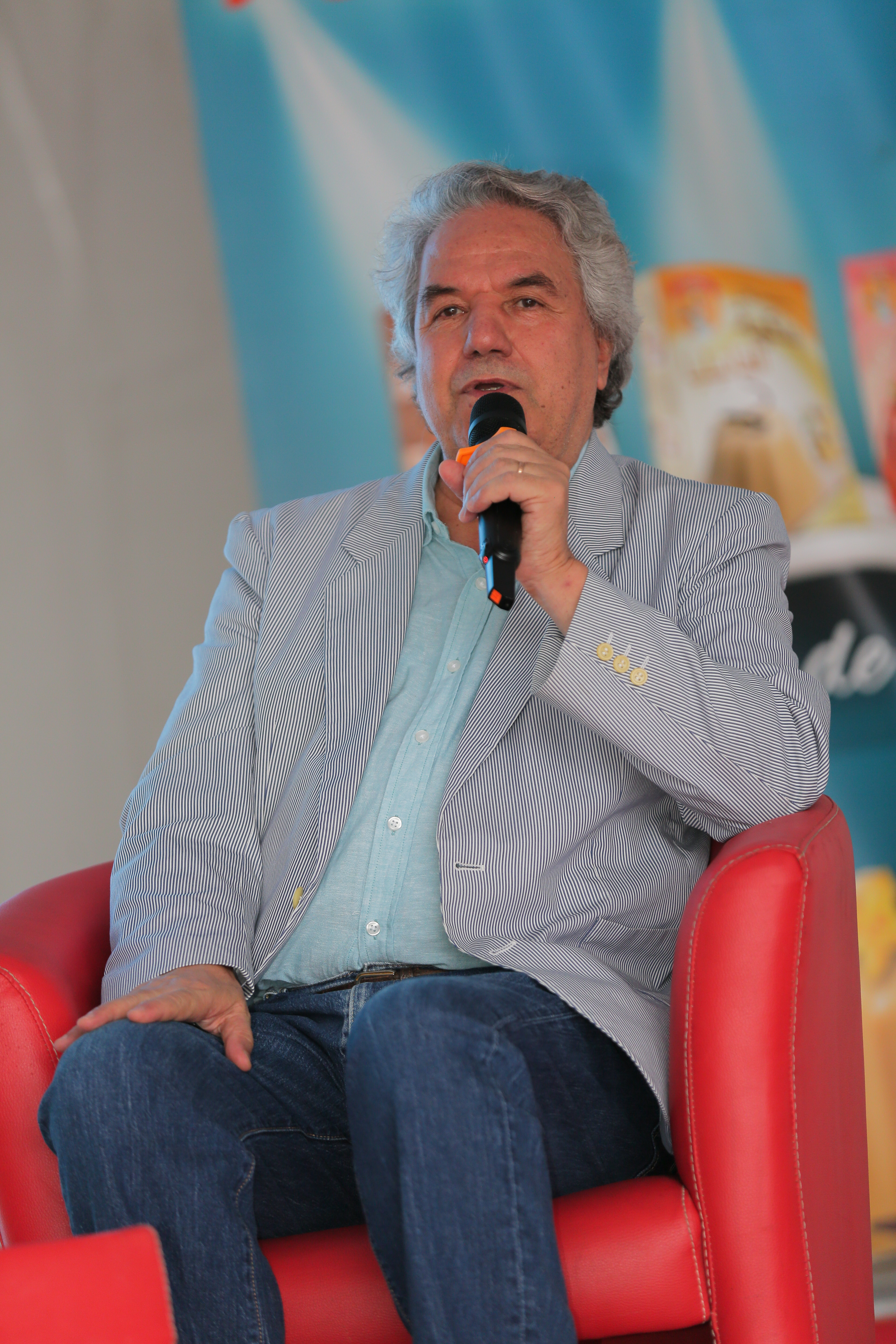
Writer and university professor Amin Zaoui gave a conference on Friday, October 2, entitled “A Bridge Between the Novel and the Graphic Novel,” moderated by writer, poet and journalist Lazhari Labter.
Amin Zaoui first spoke about his new novel, L’Orange bleue, published in French in Algeria by Dalimen Editions and in Arabic in Egypt by Dar Al-Ain. The author nevertheless stressed that the two texts are not simply translations of one another. “It is a rewriting,” he said, explaining that he first wrote the novel in French before revisiting it in Arabic, with the perspective that time and distance had given him. The plot and main characters remain common to both versions, but some differences emerge in the way the story is handled, including certain characters who appear in the French text but not in the Arabic version, and vice versa. “The plot is the same. The main characters are the same, the storyline is the same, but there is a distance between the two texts,” he emphasized.
Beyond this new publication, Amin Zaoui also spoke about the adaptation of his story Les Larmes du désert, published by Dalimen in 2023, into a graphic novel. The project grew out of his meeting with a graphic artist who illustrated the book. Another project is also currently underway. However, he noted that adapting a novel into a comic book or graphic novel is a particularly delicate exercise. Everything depends on the nature of the text. “When the novel is visual, when you can find the characters, nature, and so on, it is relatively easy to turn it into a graphic work. But when the novel is somewhat philosophical, somewhat surreal, somewhat disordered, I think it is difficult.” However, Les Larmes du désert has a feature that makes it particularly suitable for such a transformation: “This novel is, in a way, like a film. It reads like a film, and I believe it can be adapted, that it lends itself to being made into a graphic novel.”
The Image, a Generation’s First Imaginary World
This reflection naturally led Amin Zaoui to discuss his particular relationship with comics. Like many readers of his generation, he grew up with the albums and characters that accompanied his childhood. “We were readers of comics, of Mickey, Pif and others,” he recalled. At a time when television was still not widely present, comics occupied an important place in the imagination of young readers. “We grew up with radio. And then comics also came to give us images, to give meaning to gestures.” For the writer, “comics made us dream of a magnificent world, with lots of adventures, lots of colors, lots of black as well, and many different forms. All of this nourished us during our youth.”
Amin Zaoui has observed the rise of the graphic novel today as both a literary and economic phenomenon. “The graphic novel is increasingly becoming a major phenomenon, especially from an economic standpoint. Major titles sell millions of copies in France, the United States, Canada and Japan.” For him, the genre creates a unique dialogue between two forms of expression: “It is a literary phenomenon that combines two genres: comics on the one hand and literary text on the other.”
This coexistence of text and image can nevertheless be unsettling for readers accustomed to the traditional novel. “At first, you are a little unsettled when there is both literary text and an image,” he acknowledged. Some pages give prominence to the image, while others emphasize the text. This balance largely depends on the graphic artist’s work. “It depends on the artist and on how they can avoid leaving this imbalance between literary text and image. That is very important.”
Toward Greater Academic Recognition
The writer also called for greater recognition of the graphic novel within education and academic research. “If we really want to encourage the graphic novel, it must be taught at university,” he said. He also argued that the genre could have a place in school curricula, particularly at secondary-school level. “Why not teach a graphic novel to students in their final or penultimate year of secondary school? On the contrary, it could give them the pleasure of reading, perhaps more than a literary text on its own.”
For the author of Le Miel de la sieste, the image does not negate the literary text, but rather offers another way of bringing it to life. “The book, the graphic novel, is a book in motion. It is not a silent book. In literary text, words are mute, silent, but when they are illustrated, they are in motion; they are alive.”
Amin Zaoui also called for broader reflection that “takes into account the economic aspect, the aesthetic aspect, and the training of graphic artists. All of this forms a whole. Because, ultimately, a book is not merely paper and text, but an entire ecosystem built around the book.”
Through his reflections on the graphic novel, Amin Zaoui defended an open conception of literature, attentive to changes in reading practices and new forms of creative expression. “Literature is not defined by rigid, fixed genres; it is always a landscape open to other experiences and other discoveries.”